


Freight Auction Marketplace: Real-Time Carrier Bidding for SMB Shippers
Replace static quoting with live price discovery. Carriers compete in real time, and you choose the winning offer based on scope, timing, and accountability.
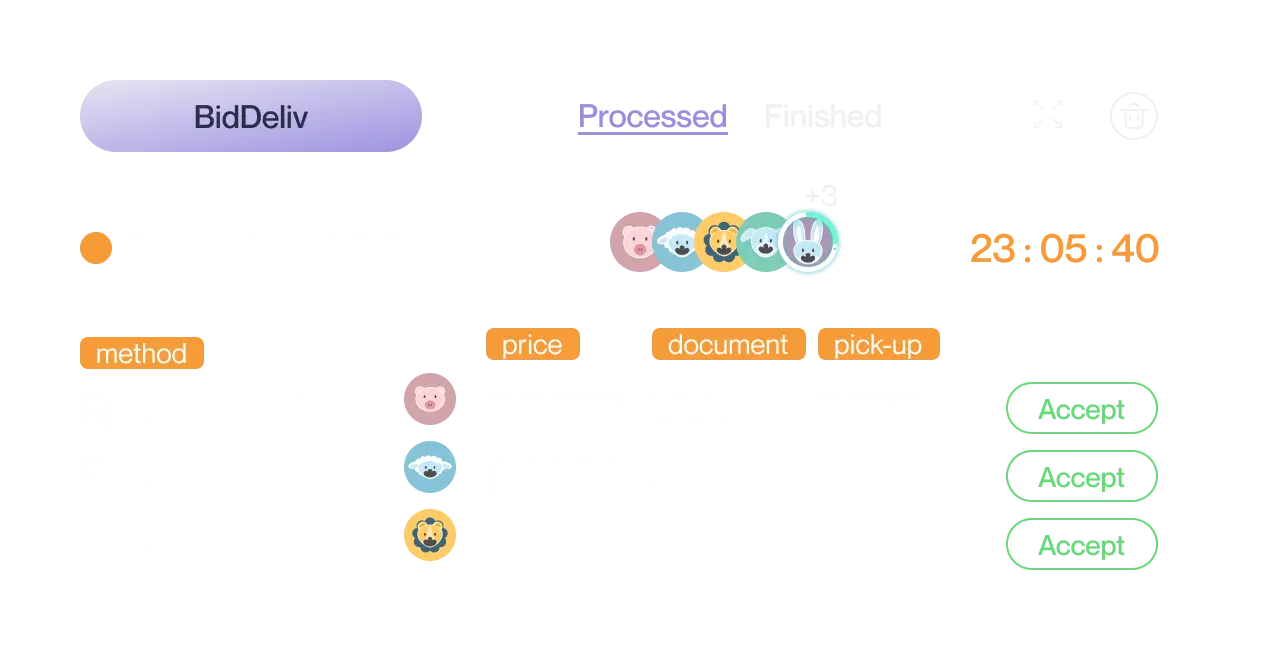
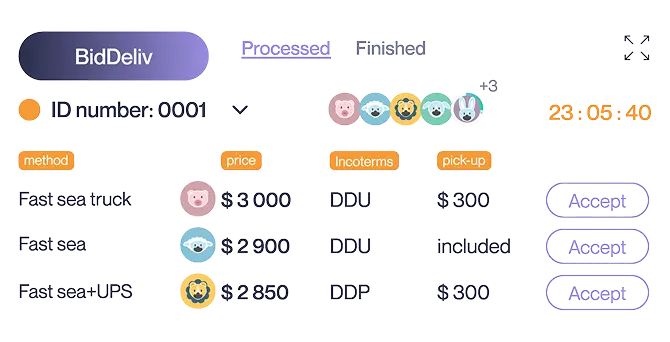
- Carriers compete in real time with all-in DDP offers
- Auctions run up to 9 business hours: accept anytime within 24 hours
- 15-40% lower costs compared to static quotes (based on 4,428 auctions)

Vitalii Savryha
Founder & CEO of AiDeliv15+ years in supply chain operations. Runs ARDI Group logistics and warehousing for Amazon and Walmart sellers. 96,000 sq ft across NJ and CA.
Why Freight Auctions Are Replacing Static Quoting
Static quoting creates three recurring problems for SMB shippers:

Delayed Decisions
3–7 days waiting for quotes

Hidden Fees
Can't compare apples to apples

Retail Pricing
Small volumes = higher margins
Quick Answer
If you are evaluating a freight auction marketplace, here is a practical summary:
What is a freight auction and who is it for?
A reverse auction where carriers bid down to win your shipment. Each bid must meaningfully beat the previous one. Best for SMB importers and e-commerce sellers shipping from Asia to the USA, Canada, or Europe. No minimum volume. You post cargo details, carriers compete, and you approve the offer that fits.
How fast do I get quotes?
Auctions run up to 9 business hours. First competitive bids typically appear within 3 hours. Compare that to 3-7 days waiting for traditional forwarder quotes. After the auction closes, you have 24 hours to review and decide.
Do I have to accept the winning bid?
No. You have full discretion. Three options when the auction closes: accept and book, reject with no penalties or fees, or start a new auction with adjusted parameters. The rate locks for 24 hours while you decide. If you do nothing, the auction expires and you owe nothing.
Won't the cheapest carrier provide the worst service?
Every carrier must meet platform requirements before bidding: cargo coverage of at least $100,000 per shipment as a platform participation requirement, documented operating history, and a customs clearance track record. BidBox analyzes multiple factors to determine which carriers qualify for each auction. Carriers that underperform lose auction access and the aggregated volume from hundreds of shippers. The cheapest bid comes from the carrier who can do it most efficiently, not the least reliable one.
Is a freight auction safe? Who is liable if cargo is lost?
The carrier bears full transportation liability. Three protection layers: all carriers maintain cargo cargo coverage of at least $100,000 per shipment as a platform participation requirement as a platform requirement; AiDeliv holds client funds as Agent of Payee until delivery confirmation and can withhold carrier funds on behalf of and for the account of the carrier to cover claims; carriers that mishandle cargo lose platform access. All communication flows through the platform, creating a documented trail for every shipment. Claims are paid from the carrier's withheld funds and insurance, up to coverage limits — AiDeliv is a marketplace, not an insurer. For full-value protection on high-value cargo, we recommend adding Marine Cargo Insurance.
Can I use a freight auction for DDP shipping to Amazon FBA?
Yes. DDP to Amazon FBA is one of the most common shipment types on AiDeliv. Carriers handle the full chain: factory pickup, freight, customs with Section 301 tariffs, FBA prep (FNSKU labels, pallets to Amazon specs), and delivery to the assigned fulfillment center. All bids are DDP by default, one all-in price. The carrier provides Importer of Record capability.
What “Reverse Auction Logistics” Means
A reverse auction is a procurement model where the price moves downward through competition. Also called: freight bidding platform, shipping auction, carrier bidding marketplace, or logistics auction.
How the AiDeliv Freight Auction Works
-
01
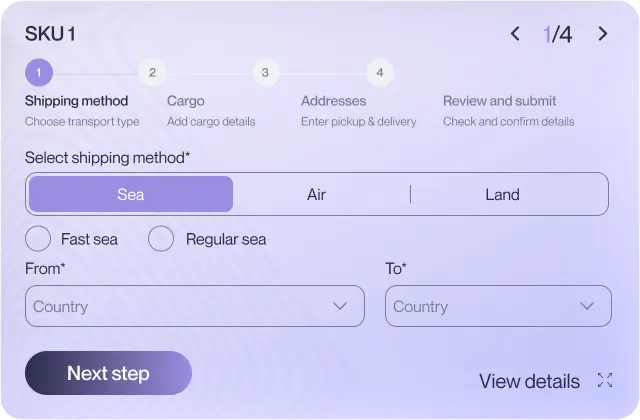
Publish Shipment
2-5 minutesRequired Information: Origin, Destination, Cargo Details (HS Code, weight, dimensions), Timeline, Special Requirements
-
02
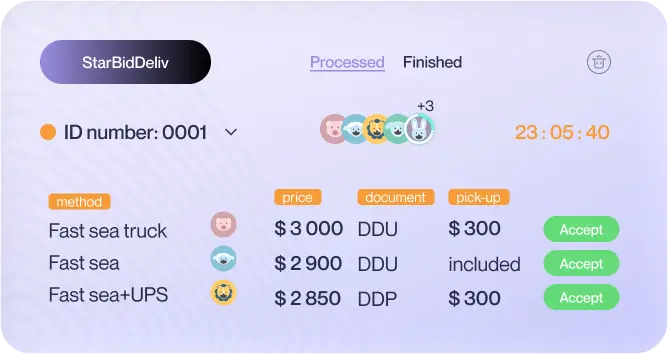
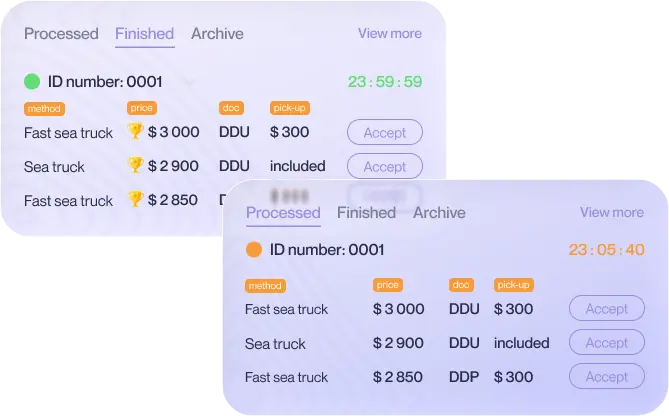
Carriers Bid
Up to 9 hoursAuction Rules:
Each bid must be lower than the previous. Carriers anonymous. You see all bids in real time. -
03
Accept Offer
Within 24 hoursThree Options:
Accept during auction, wait until auction ends, or re-run with adjusted parameters. -
04
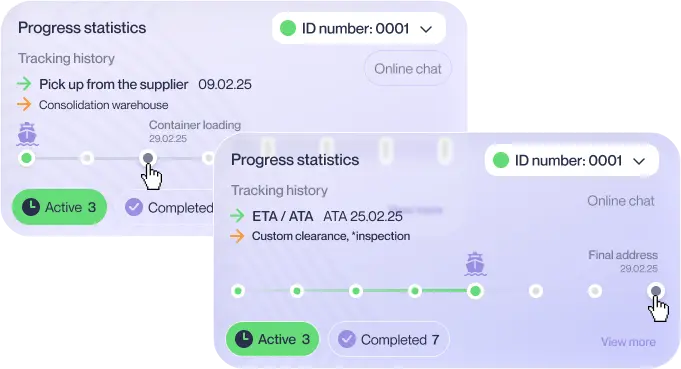
Execute & Track
AutomatedAfter Acceptance: Winning carrier receives details, contacts factory, tracking begins, documents auto-generated.
Freight Procurement Models: How They Compare
Key takeaways:
- Based on internal platform activity: 4,428 completed auctions.
- Auctions provide price discovery: carriers compete during a defined window (up to 9 business hours).
- Initial optimized bids often appear within the first 3 hours.
- Model differences mainly affect pricing transparency, responsibility allocation, and procurement speed.
| Dimension | AiDeliv Reverse Auction |
Standard Freight Marketplace (e.g., Freightos®) |
Traditional Digital Forwarder (e.g., Flexport®, Forto) |
|---|---|---|---|
| Core model | Time-boxed reverse auctions create price discovery through competing carrier bids. | Online marketplace for comparing and booking freight offers from multiple providers. | Technology-enabled freight forwarder that quotes and executes shipments. |
| Primary buyer | E-commerce SMB importers wanting market-priced procurement. | SMBs and mid-market teams seeking faster comparison. | Mid-market to enterprise shippers preferring single operator. |
| Pricing mechanism | Dynamic. Carriers submit improving offers during auction window. | Aggregated List Prices. No active price competition. | Cost-Plus Provider Quote. Fixed margin to carrier costs. |
| Key advantage | Turns fragmented quoting into competitive market event. | Speeds up quote collection by centralizing offers. | One operator to coordinate freight plus services. |
| Where it can be weaker | Requires healthy supply-side network on lane. | Quote-driven, not true price discovery. | Cost-Plus economics: less market-level leverage. |
What You Get From the Freight Auction Marketplace

Speed
vs 3-7 days

Cost
n=4,428 auctions

Time Saved
on quote management

Transparency
real-time competition
| Feature | Traditional Static Quotes | AiDeliv Reverse Auction |
|---|---|---|
| Quote Speed | 3-7 days | 3-9 hours |
| Transparency | Single opaque number | Real-time competition |
| Number of Offers | 1-3 (if lucky) | 5-15 +bids |
| Cost Savings | Retail rates | 15-40% saving |
| Hidden Fees | High risk | Lower risk (scope defined before acceptance) |
Pricing Signals and Methodology Notes
Freight rates depend on lane, seasonality, chargeable weight, cargo restrictions, and delivery point.
